Neteller — Full In-Depth Review
Introduction: Neteller’s Changing Role in the Betting Ecosystem
Neteller has long been one of the most recognizable e-wallets in online betting. For years, it was widely used across sportsbooks, poker rooms, and casinos due to its speed, accessibility, and broad acceptance. Originally launched in 1999, it pioneered the concept of a digital wallet tailored specifically for the gambling industry.
However, the role Neteller plays in betting has changed significantly. While Neteller remains a legitimate and widely accepted payment method, it is no longer suitable for arbitrage betting or high-frequency betting strategies. Policy updates, stricter compliance procedures, and bookmaker profiling have reshaped how Neteller fits into modern betting workflows.
This comprehensive Neteller review is written with that reality in mind. We have expanded our analysis to cover every aspect of the service in 2025: from the nuances of the VIP program and platform stability to a brutally honest breakdown of fees and compliance risks. This is not just a summary; it is a user manual for getting the most out of Neteller.
Pros
- Fast deposits and withdrawals
- Wide bookmaker acceptance
- Strong regulation and security
- Multi-currency support
- Established brand trust
Cons
- High fees
- Aggressive compliance monitoring
- Not suitable for arbitrage
- Increased bookmaker profiling
- Limited value for professional bettors
What Is Neteller?
Neteller is a digital wallet (e-wallet) operated by the Paysafe Group, a major financial services provider that also owns Skrill and Paysafecard. It allows users to store funds electronically and make payments online without sharing banking details directly with merchants.
In the betting context, Neteller acts as a middleman between your bank account and the gambling operator. This offers a layer of privacy—your bank statement only shows a transaction to "Neteller," not to "Bet365" or "PokerStars." This is a crucial feature for users in jurisdictions where gambling transactions might affect credit ratings or mortgage applications.
A Brief History
Founded in 1999, the company has been a staple in the industry. It was one of the first e-money issuers to be authorised by the UK's Financial Conduct Authority (FCA). Today, it serves millions of customers in over 120 countries and supports multiple currencies, cementing its status as a giant in the fintech space.
How Neteller Works for Betting Users
From a functional standpoint, Neteller is straightforward. The typical betting flow looks like this:
- Create and verify a Neteller account (takes ~5 minutes).
- Fund the wallet via bank card, bank transfer, or Paysafecard.
- Select Neteller as the payment method at a bookmaker or poker room.
- Deposit instantly (funds appear in your betting account immediately).
- Withdraw winnings back to Neteller (often processed within hours).
Detailed Breakdown of Neteller Fees
Understanding Neteller’s fee structure is critical for maintaining a profitable betting strategy. While creating an account is free, costs can accumulate quickly if you aren't careful. Here is a granular look at the fees you can expect in 2025.
Deposit Fees
Neteller charges a fee for uploading funds to your wallet. The exact percentage depends on your location and payment method, but typical global rates include:
- Bank Transfer: Often free or low cost, but can take 2-5 business days to arrive.
- Credit/Debit Card (Visa/Mastercard): Typically 2.50%. Note that some card issuers may treat this as a "cash advance," charging their own additional fee on top of Neteller's.
- Paysafecard: Up to 5.00%. This is convenient for cash users but highly inefficient due to the cost.
- Crypto Deposit: Approximately 1.00% to 2.00% depending on the asset (Bitcoin, ETH, USDT).
Withdrawal Fees
Moving money out of Neteller to your personal bank or card incurs a fee:
- Withdrawal to Bank Account: Flat fee (approx. $10). This makes small withdrawals inefficient; it's better to withdraw larger lump sums.
- Withdrawal to Visa/Mastercard: Percentage fee (up to 7.50% in some regions, though often lower for VIPs).
- Crypto Withdrawal: Approx. 2.00%.
- Neteller to Neteller (P2P): 1.45% or 2.99% for non-VIPs (Free for Silver VIP and above).
Currency Conversion (FX) Fees
This is the "hidden killer" for many bettors. If your Neteller account is in EUR but you deposit into a USD poker site, Neteller charges a currency conversion fee of 3.99% added to the wholesale exchange rate. This markup is significant.
Pro Tip: Always set your Neteller wallet currency to match the currency of the sites you play on most frequently (usually USD or EUR) to avoid this fee. If you play on sites with different currencies, aiming for Silver VIP status is mandatory as it unlocks multi-currency accounts.
Administrative Fees
- Inactivity Fee: If you don't log in or make a transaction for 6 months, a monthly service fee (approx. $5.00) is deducted from your balance. Simply logging in once every few months resets this timer.
Neteller VIP Program: Tiers and Benefits
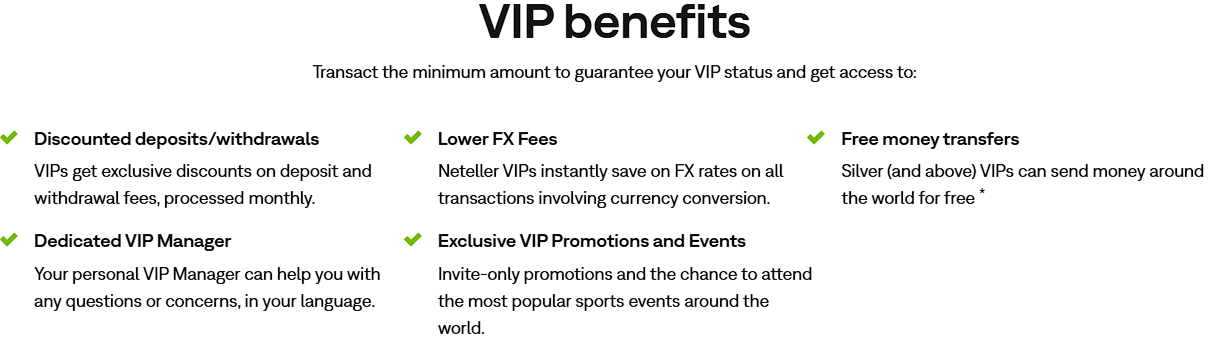
The Neteller VIP program is designed to reward high-volume users. Achieving VIP status is the most effective way to lower your costs. The program operates on a quarterly basis, meaning you must meet the transaction volume requirements every quarter to maintain your status.
VIP Tiers & Requirements
- Standard: Entry level. High fees, standard support.
- Silver: Requires substantial transaction volume.
- Benefit: Free P2P transfers.
- Benefit: Multi-currency account.
- Benefit: Reduced FX fees.
- Gold: Higher volume requirement.
- Benefit: All Silver benefits.
- Benefit: Dedicated personal account manager.
- Benefit: Higher withdrawal limits.
- Diamond: Highest volume requirement.
- Benefit: Lowest FX fees.
- Benefit: Priority bank uploads.
- Benefit: Highest security limits.
For poker players and sports bettors, reaching Silver is often the target to unlock multi-currency accounts and reduce fees.
Neteller Mobile App Review
In 2025, mobile accessibility is non-negotiable. The Neteller app (available on iOS and Android) is highly rated and serves as a full replacement for the desktop site. We tested the app extensively to see how it holds up for a bettor on the go.
Key Features
- Biometric Login: FaceID and Fingerprint support make logging in instant and secure. This is crucial when you need to make a quick deposit before a match starts or top up your poker stack.
- Real-Time Notifications: Get instant push alerts for incoming funds (winnings) or successful deposits. You no longer need to refresh your email to see if a withdrawal has landed.
- Crypto Trading: Buy and sell crypto directly within the app interface. While the fees are higher than dedicated exchanges, the convenience of converting winnings into Bitcoin instantly is a major plus.
The app is generally bug-free and responsive. The only downside is that some advanced account management features are easier to access via the desktop browser.
Neteller vs. The Competition
How does Neteller stack up against other major payment methods used in gambling? Here is a direct comparison.
Neteller vs. Skrill
Both are owned by the Paysafe Group and share very similar infrastructure. However, Skrill is generally slightly cheaper for non-VIPs, while Neteller has a historically stronger presence in the high-stakes poker community. Neteller's VIP program is slightly harder to climb but offers very similar perks. For most users, they are interchangeable.
Neteller vs. PayPal
PayPal is a household name but is extremely restrictive regarding gambling transactions. It is only available for betting in a few regulated countries (like the UK) and will block transactions to international or grey-market sites. Neteller, by contrast, is accepted by almost every gambling operator globally, making it the superior choice for international play.
Neteller vs. Crypto (Bitcoin/USDT)
Crypto offers lower fees and higher anonymity but comes with volatility and technical complexity. Neteller is faster (instant fiat deposits) and easier to use for those not comfortable with wallet addresses and blockchains. However, crypto is the only true option for users seeking to avoid the kind of "source of funds" checks that Neteller occasionally requires.

Verification (KYC) & Account Limits
Neteller is a regulated financial institution, which means you cannot use it anonymously. All users must pass "Know Your Customer" (KYC) checks to unlock the full features of the wallet. Without verification, your account will have strict deposit and withdrawal limits.
The Verification Process
To lift these limits and unlock VIP potential, you must provide:
- Proof of Identity: A clear photo of your Passport, Driver’s License, or National ID card.
- Proof of Address: A utility bill (gas, water, electric) or bank statement dated within the last 3 months. Mobile phone bills are often rejected.
- Selfie Verification: A live webcam or mobile photo to prove you are the person on the ID.
Common Verification Delays
To avoid delays, ensure your documents are high-resolution and all four corners of the page are visible. Screenshots are usually rejected; you need a photo or a PDF of the original document. Once verified, your limits increase significantly, allowing for five-figure transactions and smooth withdrawals.
Why Neteller Is NOT Suitable for Arbitrage Betting
This needs to be stated clearly and without ambiguity.
Neteller is not recommended for arbitrage betting in 2025.
Arbitrage betting involves:
- High transaction frequency
- Rapid fund movement
- Multiple bookmakers
- Short balance holding periods
Neteller’s compliance systems are specifically designed to flag this type of behavior.
As a result, arbitrage bettors commonly experience:
- Repeated account reviews
- Withdrawal delays
- Requests for betting records
- Eventual account restrictions
Even if funds are ultimately released, the operational friction makes Neteller unsuitable for systematic betting.
What Happens If You Attempt Arbitrage With Neteller
In real-world usage, bettors attempting arbitrage with Neteller often encounter:
- Multiple KYC re-verifications
- Temporary withdrawal freezes
- Reduced limits
- Permanent account restrictions in some cases
This makes Neteller unreliable for any strategy that depends on speed, scalability, or consistency.
Neteller and Bookmaker Profiling
Beyond Neteller’s own compliance checks, bookmakers themselves increasingly associate Neteller with:
- Experienced bettors
- Potentially sharp accounts
- Higher-risk customer profiles
This leads to:
- Faster stake limitations
- Reduced access to bonuses
- Shorter account lifespans
For arbitrage bettors, this creates a compounded disadvantage.
Legitimate Use Cases for Neteller in 2025
Despite these limitations, Neteller still has valid applications.
Neteller Is Suitable For:
- Recreational sports bettors
- Casino players
- Poker players
- Users making infrequent but larger bets
- Bettors who value fast withdrawals
Neteller Is NOT Suitable For:
- Arbitrage betting
- Surebetting
- High-frequency betting
- Software-driven betting workflows
- Professional betting operations
Clear positioning is essential to avoid misuse.
FAQ
Is Neteller good for betting?
Yes, for recreational and casino betting. No, for arbitrage or systematic betting.
Can Neteller be used for arbitrage betting?
No. Neteller’s current policies make it unsuitable for arbitrage.
Are Neteller withdrawals fast?
Yes, generally faster than bank transfers, subject to checks.
Does Neteller charge fees?
Yes. Fees are one of Neteller’s main drawbacks.
Is Neteller safe and regulated?
Yes. Neteller is fully regulated, but compliance checks are strict.
Final Verdict: Neteller in 2025
Neteller remains a legitimate and secure betting wallet, but its use case has narrowed considerably.
In 2025, Neteller should be viewed as:
- A premium convenience option for recreational bettors
- A solid wallet for casino and poker players
- An unsuitable choice for arbitrage and professional betting strategies
If your betting activity is occasional and straightforward, Neteller can still be useful. If your approach relies on structured, high-volume betting, Neteller no longer fits modern requirements.
Sign Up Instructions

- Open a private/incognito window to avoid old cookies.
- Click the Sign Up at Neteller button below so tracking is applied.
- Create your account with accurate details; do not enter other promo codes.
- Verify your email and complete any confirmations.
- If requested, complete KYC with a valid government ID and selfie.